
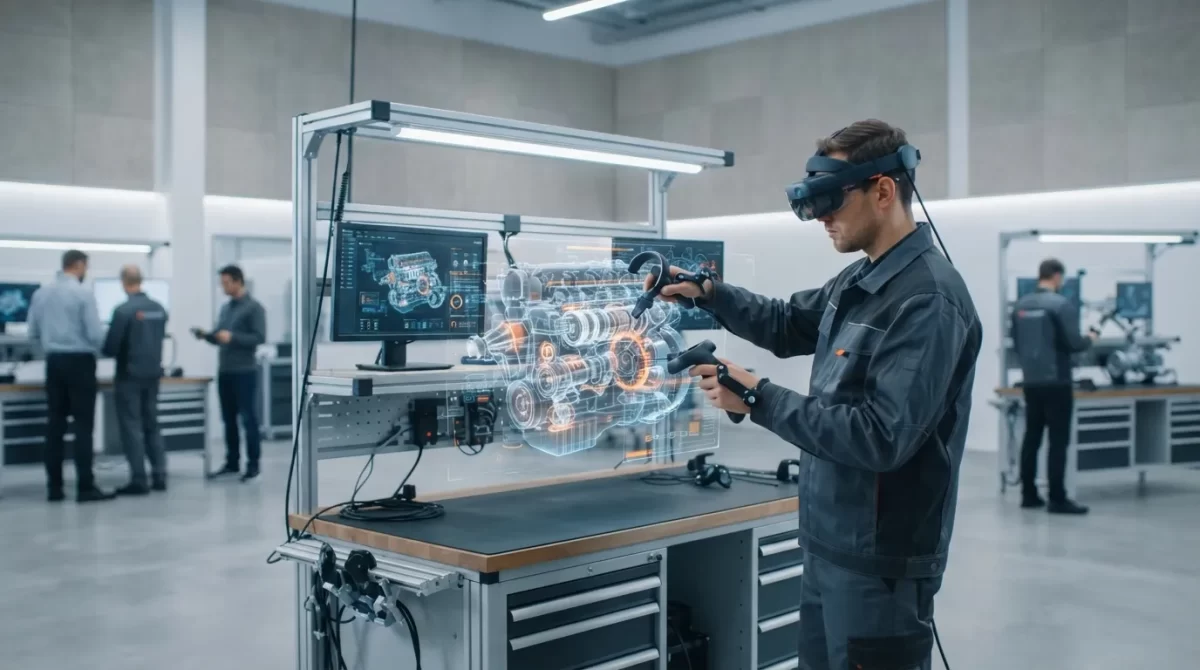
Training has always been about preparation. Whether someone is learning how to operate complex equipment, handle an emergency situation, or improve professional skills, the goal is the same: creating confidence before facing real challenges.
For decades, businesses relied on manuals, classroom sessions, videos, and basic simulations to train employees. These methods still have value, but they often miss one important element — real experience.
Extended Reality (XR) is changing that. By combining Virtual Reality (VR), Augmented Reality (AR), and Mixed Reality (MR), organizations can create realistic training environments where people can practice, make mistakes, and improve without real-world consequences.
The result is a new approach to learning: training by doing.
Why Traditional Training Has Its Limits
Many skills cannot be fully developed by reading instructions or watching demonstrations. A person may understand a process on paper but still feel uncertain when they need to perform it in real life.
This gap between knowledge and action is where XR becomes especially valuable.
Traditional training often faces several challenges:
- Limited opportunities for hands-on practice.
- High costs for equipment and instructors.
- Safety risks during real-world exercises.
- Difficulty creating realistic scenarios.
- Different learning experiences depending on the trainer.
XR helps solve these problems by creating repeatable digital environments where every learner can practice the same situation.
Learning Through Realistic Simulations
The biggest advantage of XR training is immersion. Instead of simply hearing about a task, employees can step into a simulation and experience it firsthand.
A construction worker can practice safety procedures on a virtual building site. A healthcare professional can train for complex medical situations. A factory employee can learn equipment operation without interrupting production.
| Industry | XR Training Example |
|---|---|
| Healthcare | Patient care simulations and medical procedures |
| Manufacturing | Machine operation and workplace safety |
| Aviation | Flight scenarios and emergency response |
| Retail | Customer service and communication training |
| Construction | Hazard recognition and safety preparation |
These simulations create a safe environment where learners can build confidence before entering real situations.
Mistakes Become Part of the Learning Process
One of the most powerful aspects of XR training is the ability to learn from mistakes.
In traditional environments, mistakes can be expensive, dangerous, or impossible to recreate. In a virtual environment, learners can try different approaches and understand the consequences.
For example, an employee can practice handling an emergency scenario multiple times until the correct response becomes natural.
This type of repetition helps create stronger skills because people are not just memorizing instructions. They are developing real reactions.
Making Training More Engaging
Many employees have experienced training sessions that feel disconnected from their daily work. Long presentations and endless slides can quickly become boring.
XR introduces a more active learning experience.
Instead of sitting and listening, participants interact with the environment. They make decisions, solve problems, and receive immediate feedback.
This approach can improve:
- Attention and concentration.
- Knowledge retention.
- Confidence during real tasks.
- Motivation to continue learning.
When training feels like an experience rather than an obligation, people are more likely to stay engaged.
How Companies Benefit From XR Training
Organizations are investing in immersive learning because it offers long-term advantages.
Although creating XR training programs requires initial investment, the benefits can be significant over time.
Companies can achieve:
- Lower costs for repeated training sessions.
- Reduced need for physical equipment.
- Faster employee onboarding.
- More consistent training quality.
- Better preparation for complex situations.
A digital simulation can be updated, reused, and shared across multiple locations, making it a practical solution for global teams.
The Role of AI in the Future of XR Training
XR and artificial intelligence are becoming increasingly connected. AI can make training experiences more personalized by adapting scenarios based on individual performance.
Imagine a virtual instructor that notices where an employee struggles and creates additional exercises to improve those specific skills.
Future XR training may include:
| Technology | Possible Impact |
|---|---|
| Artificial Intelligence | Personalized learning paths |
| Real-time analytics | Better performance tracking |
| Mixed Reality | More interaction with real environments |
| Cloud platforms | Easier access for global teams |
Together, these technologies can create training experiences that feel more intelligent and responsive.
The Future of Professional Learning
XR training is not just a trend. It represents a shift in how people develop skills.
The workplace is becoming more complex, and organizations need better ways to prepare their teams. Reading instructions is no longer enough for many industries. People need opportunities to practice, experiment, and build confidence.
Immersive technology makes that possible.
The future of training will not be about replacing human instructors or traditional methods. It will be about combining the best parts of both worlds.
With XR, learning becomes more realistic, more engaging, and much closer to the challenges people face every day.