
Education has always adapted to new technologies. The printing press made books more accessible, computers changed classrooms, and the internet opened the door to online learning. Now, another transformation is taking place.
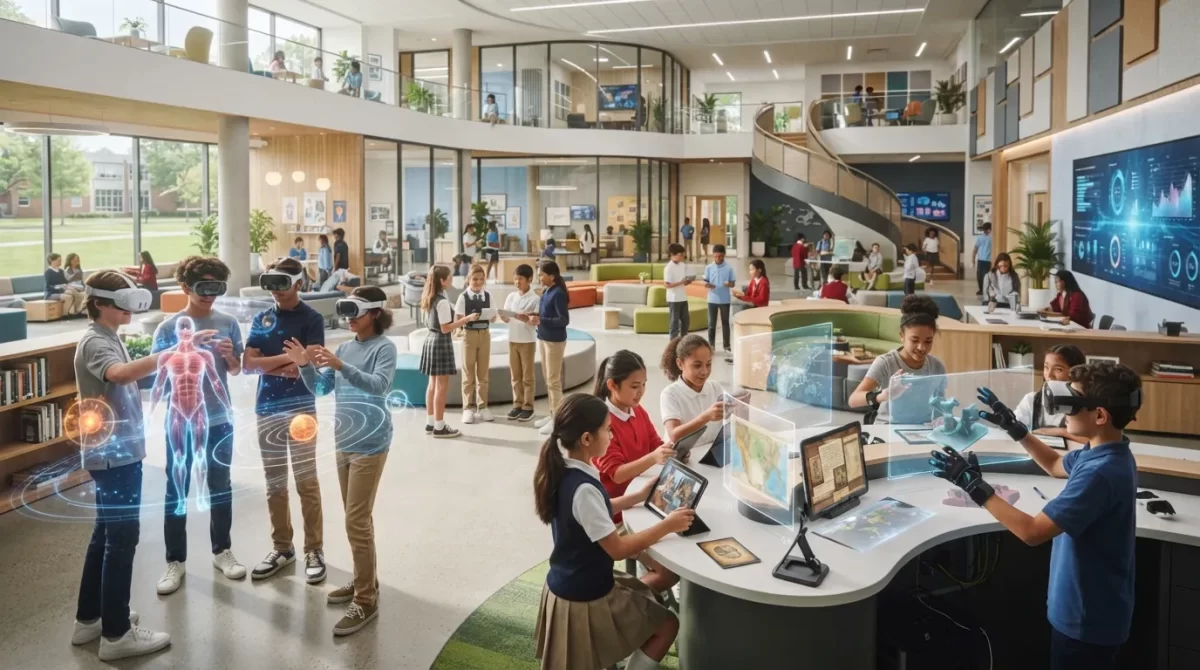
Extended Reality (XR) is bringing a new level of interaction to education and training. Instead of simply reading information or watching a video, learners can enter immersive environments, explore complex topics, and practice real-world skills in a safe digital space.
XR is not just another gadget for classrooms. It represents a different way of thinking about how people learn.
From Information Delivery to Real Experiences
For a long time, education focused on transferring information from teacher to student. A lesson was usually built around explanations, textbooks, and presentations.
But knowledge becomes much more powerful when people can experience it.
Imagine learning about the solar system by walking around virtual planets. Imagine studying architecture by entering a digital version of a building before it is constructed. Imagine medical students practicing procedures in a realistic simulation instead of only studying diagrams.
XR makes these experiences possible.
The technology allows learners to:
- Explore environments that are impossible to visit physically.
- Interact with complex concepts in three dimensions.
- Practice skills without real-world risks.
- Learn through discovery and experimentation.
This creates a deeper connection between information and experience.
Why Immersive Learning Improves Engagement
Keeping learners interested has always been one of the biggest challenges in education. A student may understand a topic during a lesson but quickly forget it afterward.
Immersive experiences create stronger memories because they involve active participation.
When learners interact with content, they are more likely to:
- Pay closer attention.
- Understand difficult concepts.
- Remember information for longer.
- Develop practical skills.
| Traditional Learning | XR-Based Learning |
|---|---|
| Reading about a topic | Exploring the topic interactively |
| Watching demonstrations | Participating in simulations |
| Memorizing processes | Practicing real actions |
| Limited environments | Unlimited virtual scenarios |
XR does not make learning easier by removing effort. It makes learning more effective by creating better ways to understand information.
XR Is Changing Different Areas of Education
One of the most exciting parts of XR is its versatility. The technology can support almost any field where visualization and practice are important.
Healthcare Education
Medical training is one of the strongest examples of XR adoption. Students can study anatomy through detailed 3D models and practice procedures in realistic simulations.
This allows future professionals to gain confidence before working with real patients.
Science and Engineering
Many scientific concepts are difficult to understand through traditional materials alone. XR allows students to explore molecules, machines, and complex systems from different perspectives.
Instead of looking at a static image, learners can interact with the subject directly.
Professional Development
Companies are also using XR to improve employee training. From safety procedures to leadership skills, immersive simulations help workers prepare for real situations.
The same principle applies everywhere: practice creates confidence.
Breaking the Limits of Location
One of the biggest advantages of XR is accessibility.
A student in one part of the world can explore experiences that would normally require expensive travel or special equipment. A small school can provide virtual laboratory experiences without building a physical facility.
XR has the potential to make high-quality learning experiences available to more people.
However, technology alone is not enough. Successful implementation requires good educational content, trained teachers, and thoughtful planning.
The Challenges Ahead
Like any emerging technology, XR faces some obstacles.
Cost remains one of the main concerns. Devices and development of high-quality educational content require investment. Some institutions also need time to train educators and adapt their teaching methods.
There are also questions about digital accessibility and ensuring that all learners can benefit from these tools.
The goal is not to replace traditional education but to expand it.
A New Era of Learning
Extended Reality is changing the relationship between people and knowledge. Instead of seeing education as something that happens only inside a classroom, XR creates opportunities to learn anywhere and through almost any experience.
The future learner may not just read about history, science, or technology. They may walk through it, interact with it, and understand it from the inside.
XR will not replace teachers, books, or human connection. Those elements will remain essential.
But it will add something powerful: the ability to transform ideas into experiences.
And sometimes, the best way to truly understand something is not to hear about it — but to step inside it.