
For generations, learning followed a familiar pattern: a teacher explained a topic, students read materials, completed exercises, and tried to remember the information long enough to pass an exam.
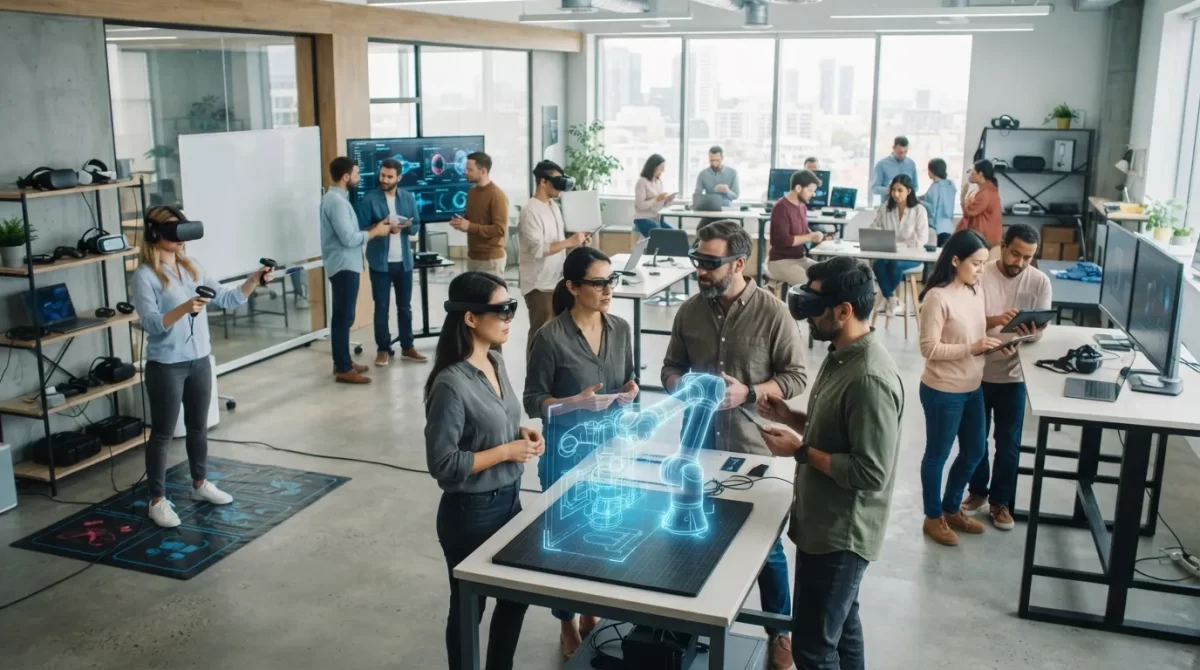
That model still works, but technology is opening new possibilities. Today, learning does not have to happen only through books, screens, or lectures. With Virtual Reality (VR) and Augmented Reality (AR), students can explore, experiment, and interact with knowledge in ways that were impossible before.
Instead of asking learners to imagine a place, process, or situation, immersive technology allows them to experience it.
That simple change can completely transform education.
From Passive Learning to Active Experience
One of the biggest challenges in education is keeping people engaged. Reading a long explanation or watching a traditional presentation does not always create a strong connection with the subject.
XR changes the role of the learner. Instead of being a passive observer, a student becomes an active participant.
For example:
- A history student can walk through a virtual reconstruction of an ancient city.
- A medical student can explore human anatomy in a 3D environment.
- An engineering student can interact with complex machines before working with real equipment.
- A geography class can visit places around the world without leaving the classroom.
When people actively participate, information becomes easier to understand and remember.
Virtual Reality Creates New Learning Environments
Virtual Reality places users inside a completely digital world. Using a VR headset, learners can enter realistic simulations designed for education and training.
The possibilities are almost endless.
A chemistry student can safely perform experiments without worrying about dangerous materials. A pilot can practice emergency situations without taking a real aircraft into the sky. A firefighter can train for difficult scenarios without real-world risks.
| Learning Area | VR Application |
|---|---|
| Medicine | Surgery simulations and clinical practice |
| Aviation | Flight training and emergency scenarios |
| Engineering | Equipment operation and design testing |
| History | Virtual visits to historical locations |
| Science | Interactive experiments and exploration |
VR creates a space where mistakes become part of learning instead of something to fear.
Augmented Reality Brings Digital Information Into the Real World
While VR creates a fully digital environment, Augmented Reality adds virtual elements to the physical world.
AR works through devices such as smartphones, tablets, and specialized glasses. It allows learners to see additional information layered on top of real objects.
For example, students studying mechanics can point a device at a machine and see labels explaining each component. Architecture students can view 3D models directly inside a physical space. Biology students can examine interactive digital models of organs.
AR makes everyday environments more informative and interactive.
Why Immersive Learning Works
People often remember experiences better than simple information. This is why hands-on activities have always been an important part of education.
XR supports this idea by combining visual learning, interaction, and practical experience.
Some major benefits include:
- Higher engagement: Interactive lessons capture attention more effectively.
- Better understanding: Complex ideas become easier to visualize.
- Safe practice: Students can learn through trial and error without serious consequences.
- Equal access: Learners can experience locations and situations that may otherwise be unavailable.
A student who struggles with traditional learning methods may discover a completely different way to understand information through immersive experiences.
Challenges on the Road Ahead
Despite its potential, XR education still faces some challenges. Equipment costs, technical requirements, and teacher training remain important considerations.
Schools and organizations need proper strategies before introducing immersive technology. Buying devices alone is not enough. The content, teaching methods, and learning goals must all work together.
There are also questions about accessibility. Not every student currently has equal access to advanced technology, so developers and educators need to consider affordable solutions.
A New Chapter for Education
Virtual and augmented reality are not replacing teachers or traditional learning methods. Instead, they are expanding what is possible.
The classroom of the future may include both physical and digital experiences. Students might attend a regular lesson, then explore a virtual environment to deepen their understanding. Professionals might combine online courses with realistic simulations to improve their skills.
The biggest change is not the technology itself. It is the way people interact with knowledge.
Learning is becoming less about memorizing information and more about experiencing, exploring, and understanding.
With XR, education is moving beyond the classroom and into a world of unlimited possibilities.