
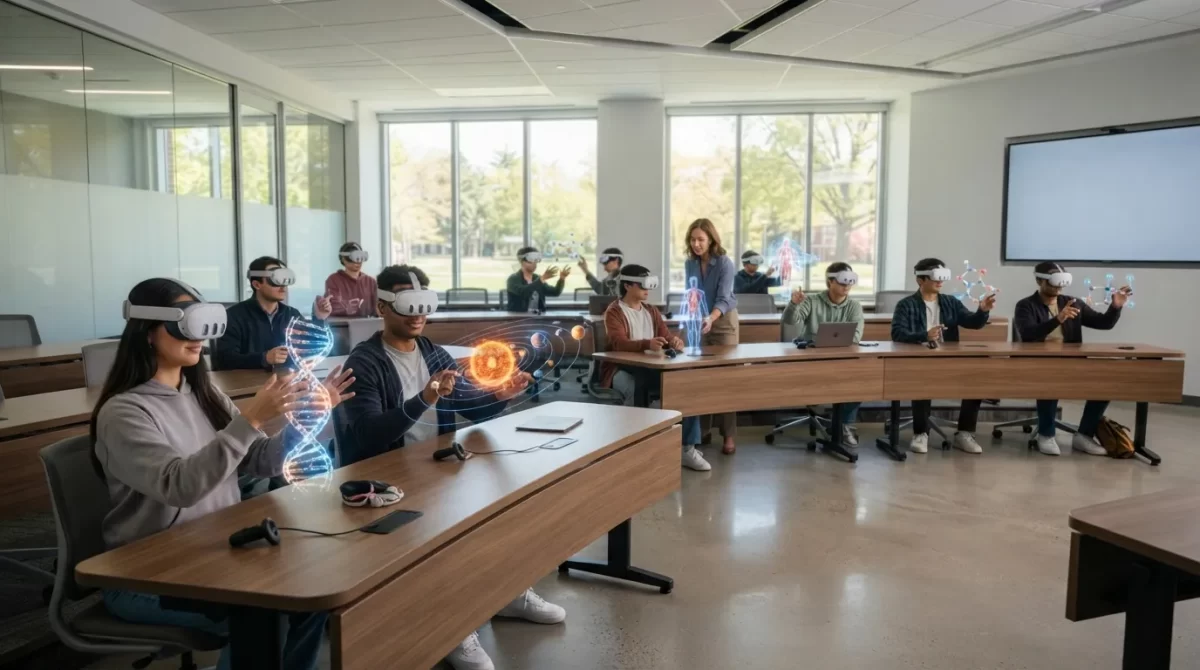
Learning has always evolved alongside technology. From textbooks and blackboards to online courses and video lessons, every new tool has changed the way people gain knowledge. Now, another shift is happening — and it is bringing learning into a completely new dimension.
Extended Reality (XR), which includes Virtual Reality (VR), Augmented Reality (AR), and Mixed Reality (MR), is changing how students, employees, and professionals experience training. Instead of simply reading about a topic or watching a demonstration, learners can step inside realistic digital environments and actively participate.
The difference is huge. Learning becomes something people do, not just something they watch.
What Makes XR Learning Different?
Traditional education often depends on explanation and imagination. A student reads about the human body, studies a machine from a manual, or listens to a teacher describe a historical event.
XR changes that experience by making abstract ideas visible and interactive.
With immersive technology, learners can:
- Explore complex concepts in a 3D environment.
- Practice skills without real-world risks.
- Repeat training scenarios as many times as needed.
- Learn through experience instead of memorization.
- Interact with digital objects and simulations.
This approach helps people understand information faster because they are not just receiving knowledge — they are experiencing it.
Learning by Doing Creates Stronger Results
There is a big difference between knowing something and actually being able to do it.
A medical student can study hundreds of pages about surgery, but practicing in a realistic simulation creates a completely different level of understanding. A technician can read a repair manual, but working with a virtual machine provides valuable hands-on experience.
XR makes practice safer, more accessible, and often more engaging.
| Traditional Training | XR-Based Training |
|---|---|
| Reading instructions | Interactive simulations |
| Watching demonstrations | Performing realistic tasks |
| Limited practice opportunities | Unlimited repetition |
| Learning in one environment | Training in any virtual scenario |
This does not mean traditional methods will disappear. Instead, XR adds another powerful layer that improves the overall learning process.
XR in Education: From Classrooms to Virtual Worlds
Schools and universities are exploring XR to make difficult subjects easier to understand.
Imagine a biology class where students can explore a human cell from the inside. Or a history lesson where learners can walk through an ancient city instead of simply looking at pictures.
Subjects that once felt distant can become much more engaging.
Some examples of XR education include:
- Virtual science laboratories.
- Interactive geography experiences.
- Historical recreations.
- 3D engineering models.
- Language learning simulations.
The biggest advantage is curiosity. When students can explore and interact, learning becomes more exciting.
The Rise of Immersive Corporate Training
XR is not only changing schools. Businesses are also discovering the benefits of immersive training.
Companies use XR to prepare employees for situations that are expensive, dangerous, or difficult to recreate in real life.
Examples include:
- Safety training for industrial workers.
- Emergency response simulations.
- Customer service practice.
- Leadership and communication exercises.
- Technical equipment training.
Employees can build confidence by practicing realistic scenarios before facing them in the workplace.
Why Companies Are Investing in XR Learning
Organizations are looking for better ways to train people efficiently. Traditional training methods can require travel, equipment, instructors, and significant time investments.
XR can reduce some of these challenges by creating reusable digital environments.
Key benefits include:
- Lower training costs over time.
- Better engagement from learners.
- More consistent training experiences.
- Improved knowledge retention.
- Safer practice environments.
The technology is especially valuable for industries where mistakes can be costly or dangerous.
The Future of Learning Is More Immersive
XR is still developing, but its impact on education and training is already becoming clear. As devices become more comfortable, affordable, and powerful, immersive learning will become easier to access.
The future classroom may not be limited by walls. The future workplace may not require learners to wait for real-world opportunities to practice.
XR does not replace teachers, trainers, or human interaction. Instead, it gives them a new tool to create deeper and more meaningful experiences.
Learning has always been about discovery. XR simply gives people new worlds to discover.